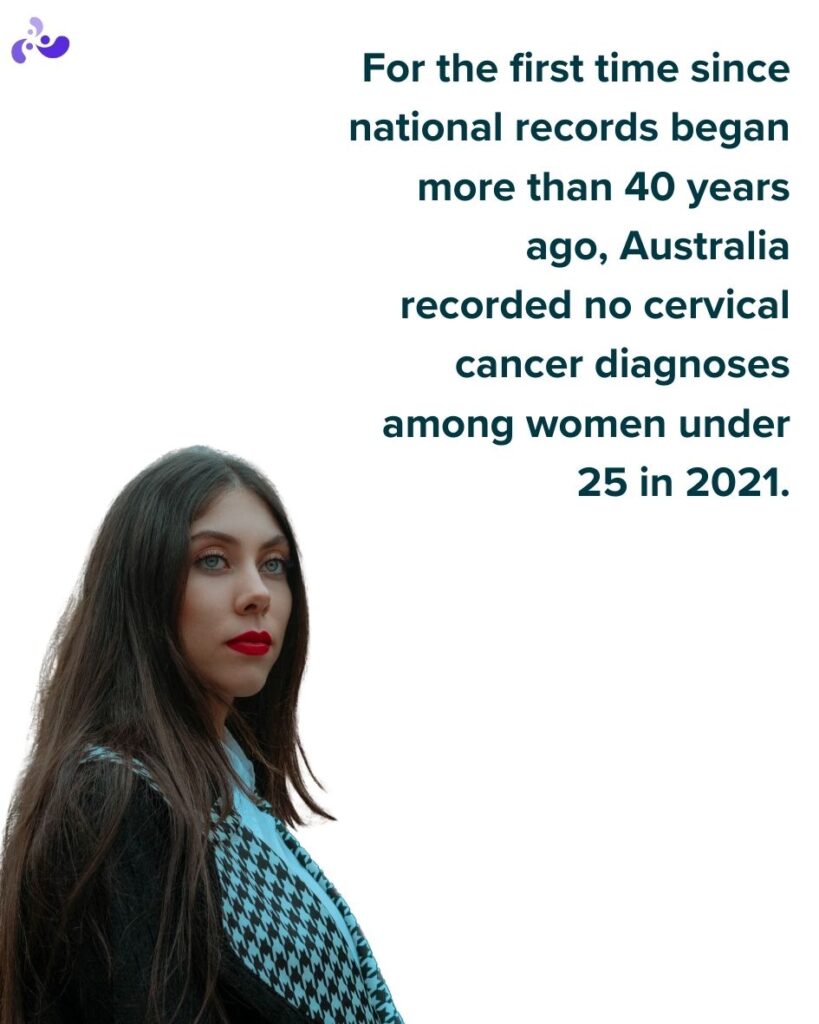
For the first time since national records began more than 40 years ago, Australia recorded no cervical cancer diagnoses among women under 25 in 2021.
The finding announced in the Cervical Cancer Elimination Progress Report points to Australia’s HPV vaccination program, introduced in schools in 2007, as a major driver of the achievement.
The national report tracks cervical cancer trends, vaccination rates, and screening. It says it shows “on track to become the first country to eliminate cervical cancer by 2035”.
Jess Davidson, General Manager of the Illawarra Women’s Health Centre, the finding is something to celebrate.
“These statistics show what’s possible when women have access to vaccination, good information and early testing,” she said.
Young women today are being protected in ways their mothers and grandmothers never were.”
Five-year survival for cervical cancer also continues to improve, reaching 76.8% for women diagnosed between 2017 and 2021.
The C4 report highlights that 957 cervical cancer cases were diagnosed in Australia in 2021, – around 6.3 cases per 100,000 women.
The organisations said the shift to the HPV screening test in 2017, replacing the traditional Pap smear, is also helping to detect early abnormalities before they develop into cancer.
The Illawarra Women’s Health Centre offers free cervical screening tests through its Nurse Practitioner.
“Cervical screening is one of the most powerful tools we have to prevent cervical cancer,” Ms Davidson said.
“The HPV test picks up changes long before they become dangerous. Making sure women in the Illawarra can access it easily is a core part of our work.”
But Davidson says the reduction in cervical cancer cases is tempered by another major national report showing ovarian cancer remains one of the deadliest cancers affecting Australian women, with survival barely improving in decades.
The report, The Value of Hope, estimates that 1,805 women were diagnosed with ovarian cancer in 2024.
Even though it makes up only a small percentage of female cancers, it is still the fifth leading cause of cancer death among Australian women. Fewer than half of those diagnosed live beyond five years.
The report explains how one of the biggest challenges is that ovarian cancer is usually diagnosed late.
The symptoms are vague, and there is no screening test that can detect it early, unlike cervical cancer.
“Cervical screening has been a public-health success story. It shows what happens when prevention, science and access come together,” said Ms Davidson.
“Ovarian cancer hasn’t had that chance, and that’s why survival hasn’t improved in decades. We need the same agency to change that.”
The Centre offers free cervical screening tests through its Nurse Practitioner, contact us on 4255 6800 to book an appointment.