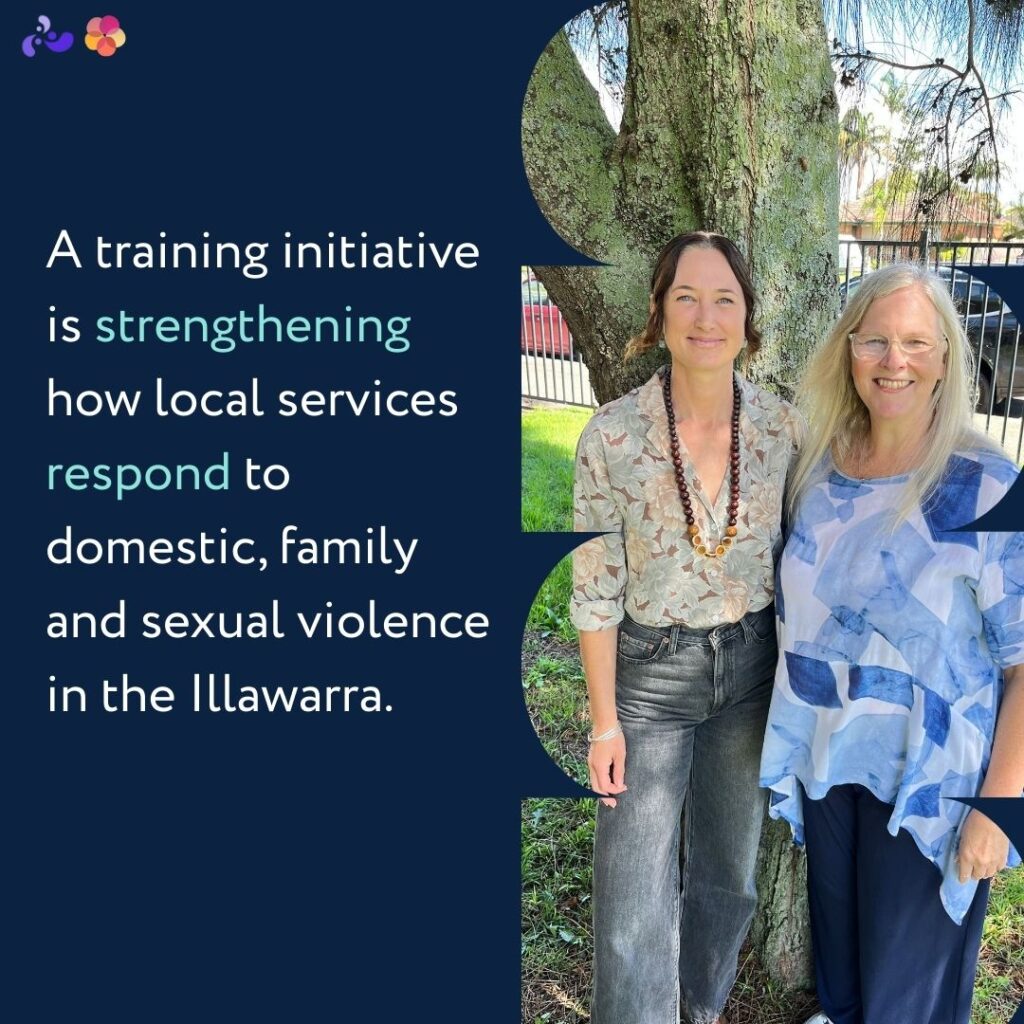
A new training initiative is strengthening how local services respond to domestic, family and sexual violence in the Illawarra.
Workers from the Illawarra Women’s Trauma Recovery Centre and the Illawarra Women’s Health Centre are completing a four-day Safe & Together program designed to prioritise children’s safety and place responsibility for harm on the person using violence.
Led by Safe & Together Institute-accredited facilitators Ganga Ashworth and Aimee Jackson from the Illawarra Women’s Health Centre, the training brings together workers from both organisations to build a child-centred, perpetrator-accountable approach – one that recognises children as victims in their own right and places responsibility firmly on the person who uses violence.
The Safe & Together model is an internationally recognised approach used across child protection, legal and social service systems. It aims to keep children safe and, where possible, together with the non-offending parent, while holding perpetrators accountable for their behaviour.
Ms Ashworth and Ms Jackson say the training is about more than learning new information – it’s about giving workers the tools and confidence to act on what they already know.
“We often say this training gives workers permission to work to the values and truths they’ve always held,” they explained.
“The knowledge isn’t new, but the model provides structure and language so workers can put that knowledge into practice safely.”
The training explores how domestic and family violence affects parenting, wellbeing and child development, and how systems sometimes unintentionally shift responsibility onto mothers.
“Historically, systems have labelled women as ‘non-protective’,” Ms Jackson said.
“This model highlights the protective actions women take every single day within the context of violence and recognises that the source of harm is the person using coercion and control.”
A core element of the training is reframing how professionals understand children’s experiences of domestic violence.
Rather than being witnesses, children are recognised as directly impacted, emotionally, developmentally and physically, often with lifelong health and mental health effects.
“Children aren’t just bystanders,” Ms Ashworth said.
“They are victims in their own right. Violence affects their development, their well-being, and their sense of safety. Our role is to support healing and recovery for both children and the non-offending parent.”
The training encourages practitioners to view abusive behaviour as a parenting choice made by the perpetrator – one that interferes with the other parent’s ability to care for their children.
Workers supporting families experiencing domestic violence often navigate courts, child protection systems and risk assessments.
The Safe & Together approach provides guidance on documentation and communication that strengthens safety for families and practitioners alike.
Illawarra Women’s Health Centre General Manager Jess Davidson said the framework works alongside women, not against them.
“This model helps us clearly show how women are protecting their children and keeps the focus on the person using violence,” she said.
“It means our involvement strengthens a woman’s safety and supports her if she has to navigate family court or child protection.”
Across Australia and internationally, courts and statutory systems are increasingly adopting the Safe & Together language, enabling clearer collaboration between services.
Both Centres see the training as part of a broader commitment to trauma-informed, domestic violence-informed practice across the region.
By strengthening collaboration, documentation and understanding, the program aims to ensure that women are supported rather than blamed, and that children’s experiences are recognised and addressed.
“Ultimately, this is about keeping women and children safe, supporting healing and recovery, and holding perpetrators accountable,” said Elise Phillips, CEO of the Illawarra Women’s Trauma Recovery Centre.
“When services work together with shared understanding, the potential for change is enormous.”
The Illawarra Women’s Health Centre can provide Safe & Together training for other organisations in the Illawarra and beyond. Contact 4255 6800 or training@womenshealthcentre.com.au for more information.